

“You can’t be an artist if you only know your art”
Interview with Lionel Rogosin
Eric Breitbart: Could you tell me about your background?
Lionel Rogosin: I was born in New York City; but when I was fairly young, we moved to Port Washington [on New York’s Long Island]. It was suburban, but there was the Bay and the Sound. I did a lot of fishing and boating. When I became a film person, I changed my interests from nature to cinema.
Do you see nature and cinema as opposites?
No, I see them as very close. For me, cinema is a way of seeing nature. It’s like being a painter. It’s just that I don’t see landscapes – I see people. I’d love to make a film about the sea, though. That’s one of my dreams, but I’ve never come close to it. It’s such an incredible subject for cinema.
When you were growing up, did you think you would become a filmmaker?
No, I didn’t have the slightest idea. I had seen Flaherty’s Man of Aran when I was very young – about 12, I think – and I was very excited by it. The film inspired me. I would say that was the beginning, though I wasn’t conscious of it. It’s interesting that the film is about the sea. Of course, it’s also Flaherty. He was an important filmmaker for me.
When you started making films, were you conscious of being part of a documentary tradition?
Yes, though I don’t like the word documentary. It’s an inaccurate word. I don’t know why Grierson ever used it. To call a documentary “the creative expression of reality” just doesn’t make sense. Creative expression of reality is not documentary, which means document, or fact. Even cinema vérité, which is not my kind of film, is a better choice of words. It’s not so deadening as “documentary.” Let’s just say that when I started, I was working in Flaherty’s and De Sica’s “direction.” I’d seen the neorealist films after the War, and what I was aiming for was to fuse the two genres — Flaherty’s poetic films and the fictional narratives of the neorealists — which is what Come Back, Africa is, hopefully.
So, one day you decided to become a filmmaker?
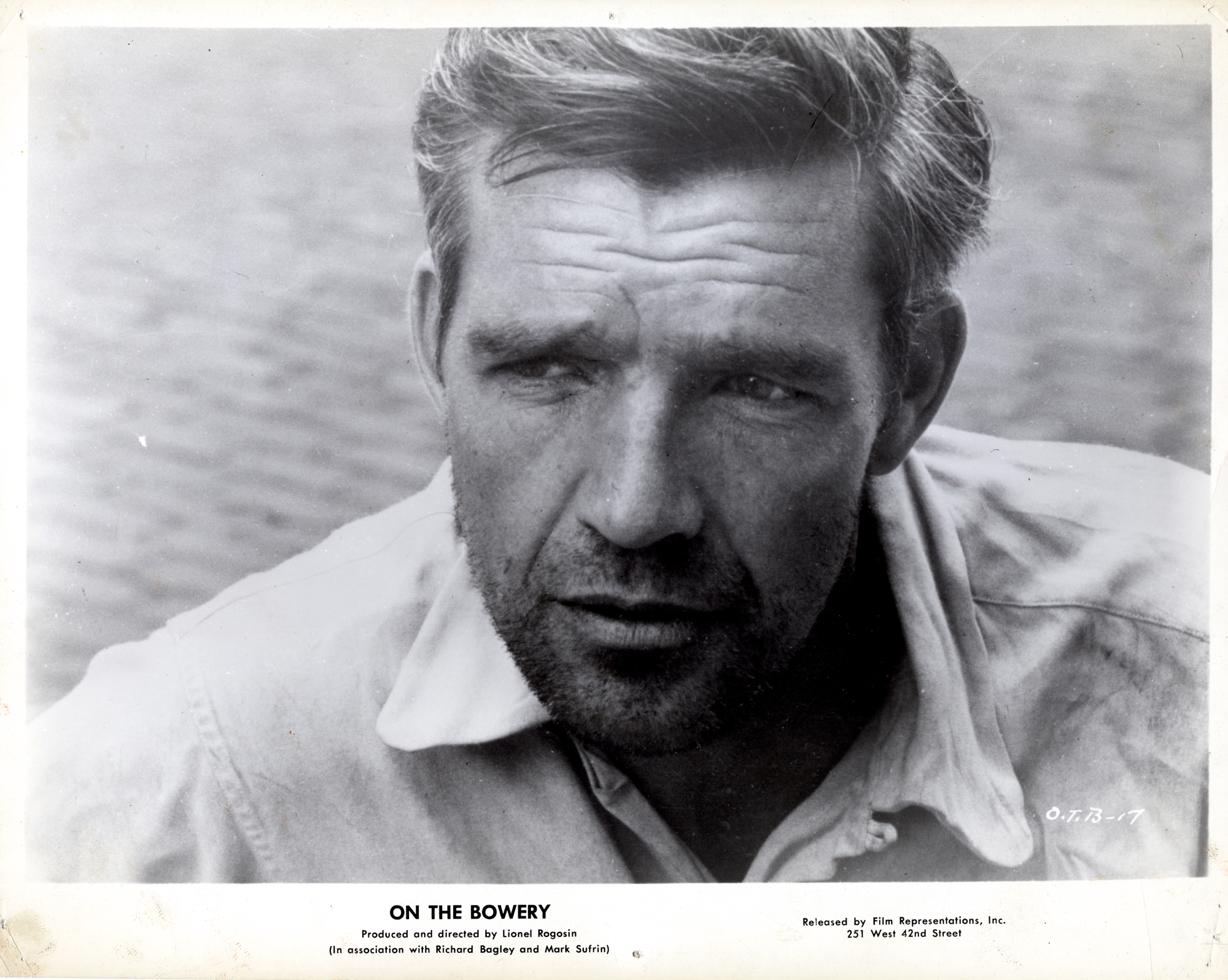
Pretty much. I was working in a corporation, and I’d accumulated enough money to make On the Bowery. It was a self-financed, low-budget production.
What was a low budget in those days?
About $30,000.
It was shot in 35mm?
Yes, I had two of the best people in New York for my first film — Dick Bagley shot it, and Carl Lerner cut it.
Bagley wasn’t as well known as Lerner. Bagley didn’t do many films, just a few commercials and industrials. He lived in Italy for a long time. He also drank a lot. Five years after he shot On the Bowery, he died of alcoholism, at 37 or 38; so he was very close to the subject of On the Bowery. I knew he was a heavy drinker; and after the first day, I knew he was an alcoholic. But we screened the rushes and everything was in focus, so I said OK. He did a beautiful job.
How long did it take to shoot the film?
Three months. It took six months to edit. It should have taken three, but we messed everything up trying to edit it ourselves. None of us knew what we were doing, until I hired Carl Lerner. The poor man had to reassemble the footage before he could do anything.
Did you have a script?
We had an outline of two pages, that was enough to give it some direction. I really just shot it off the top of my head. I knew the subject so well, I didn’t need a script since I’d spent six months observing on the Bowery. I knew Flaherty had spent three years in Aran, and a lot of time with the Inuit. That’s the primary thing for that kind of film – to spend a lot of time on-location with the subject.
Did you have an idea of an audience, or how you would distribute it?
I was very naïve about distribution. I knew The Quite One and The Little Fugitive had been made and shown theatrically, so I figured I would do that. The budget was extremely low, so I didn’t expect much. On the Bowery was a learning film, then I would make Come Back, Africa. I didn’t expect On the Bowery to be successful, or to get the kind of acclaim that it did; nor did I think it would be so difficult to get any sort of income or distribution. I worked like hell and, at the end of three years, there was nothing, in terms of income.
Did you self-distribute On the Bowery?
I started it. I took it to Venice where it won the Grand prize; and it also won a British Academy Award. I got a British distributor who offered me a $3,000 advance and then changed his mind. Another distributor offered to do it for no advance and 50 percent. Then I opened it here at an art cinema – the 55th St. Playhouse – with Cy Harvey, who started Janus. It played for a month, which was very good for that kind of film. We got good publicity, except for an attack by New York Times’ critic Bosley Crowther. He really hated the film. Harvey said I was finished, that the review killed the film. I think he was wrong. I don’t think it could have had any distribution around the country anyway. On the Bowery just had no commercial appeal. Most distributors saw it, threw up their hands and said, “Who’s going to show this?” It was shown on CBS-TV’s Omnibus, and that was that until I got in on 16mm. Leo Dratfield took it for Contemporary Films, and got some bookings. He really did a good job for independent filmmakers.
You really pre-dated the whole wave of independent filmmaking, didn’t you?
There were a few of us – Shirley Clarke, Sidney Meyers, Jonas Mekas, Emile de Antonio. We started a group around 1960. It was so anarchistic, it was doomed to failure. About 50 of us got together in a room in New York.
We issued a manifesto and, within six months, the group fell apart. Then Jonas started the Film-Makers’ Coop, which did pretty well, relatively speaking. Around the same time, I started the Bleecker Street Cinema. I wanted a theatre for myself and for other filmmakers. It was useful for filmmakers for awhile, for ten years maybe.
How did you raise the money for Come Back, Africa?
I didn’t make any money from On the Bowery, but I had something of a reputation, so I was able to raise about two-thirds of the money. It was also very inexpensive. Filming in South Africa cost very little, except for travel.
Did you consider yourself a radical filmmaker, someone who wanted to promote social change?
That was my aim… Unfortunately, Come Back, Africa has never been shown on television here. If we had a consistent television outlet, we could have continued to make films. By “we,” I mean all the filmmakers making social films, from 1960 till today…
You’ve logged over 30 years experience as an independent filmmaker. If you were going to give advice to filmmakers today, what would it be?
First, I’d have to say that I don’t have any easy answers. I don’t have any choice. I can’t stop trying to make films. If I could write novels, maybe I would do that. It’s a tough question. Maybe living in another country is important. It helps you see clearer. You need experience with life. You can’t be an artist if you only know your art… There’s a passage from Dostoevsky that means a lot to me: “Man is an enigma. This enigma must be solved. And if you spend all your life at it, don’t say you have wasted your time. I occupy myself with this enigma because I wish to be a man.” I’m not saying that every filmmaker should think of that, and make it his aim; but it’s a pretty incredible concept.
This text was originally published in Sightlines, Summer/Fall, 1987.
Many thanks to Joshua Breitbart.

