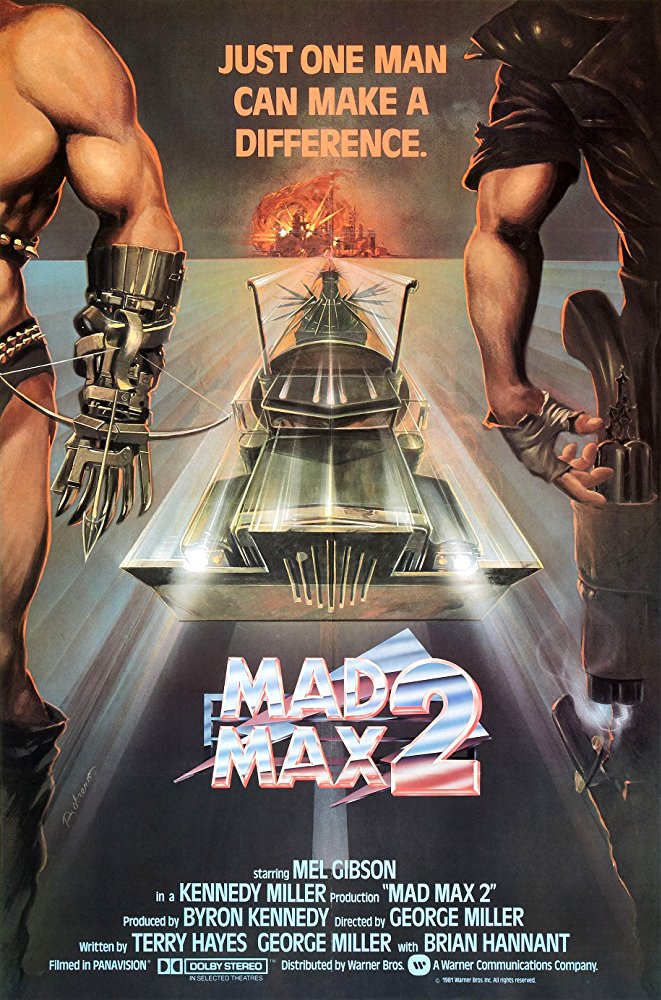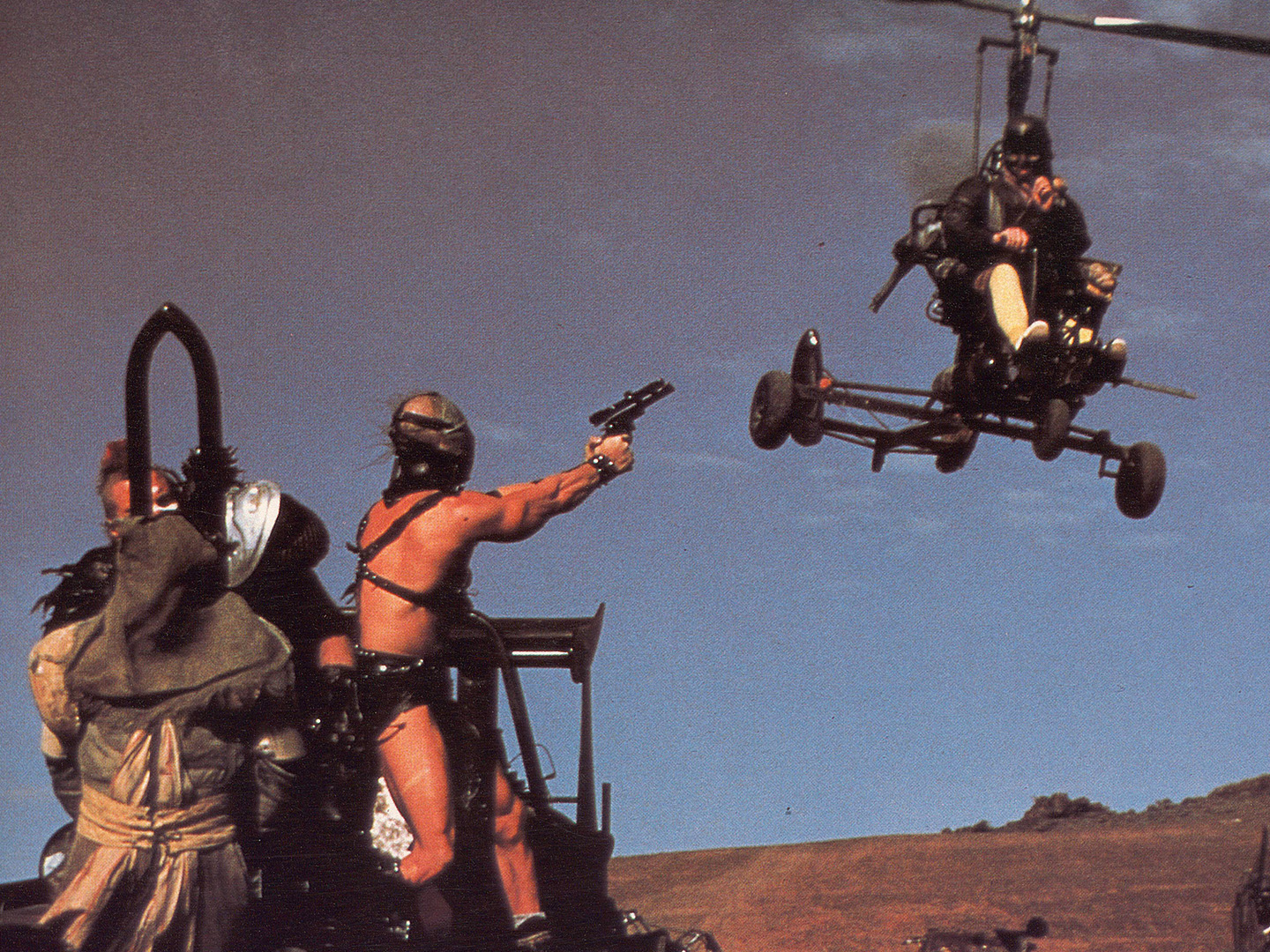
In the post-apocalyptic Australian wasteland, a cynical drifter agrees to help a small, gasoline-rich community get rid of a horde of bandits.
EN
George Miller: I knew we had to set it in some kind of a future, but we didn’t have the budget to set it far in the future. We couldn’t change the locations very much from the way they already were. But setting something even slightly in the future allows you to exaggerate, to use hyperbole. You can invoke things that are almost mythological, that are unconscious and intuitive. The kinds of things you use in westerns just wouldn’t fit in a current, naturalistic drama.
Neither Mad Max nor The Road Warrior is really speculative about a future, though. It’s a lot of stuff that is clearly exaggerated from the present. There was petrol rationing in Australia then and it was surprising how quickly things disintegrated. After just three or four days there was always some kind of aggression in the petrol queues. People’s normal life-style was threatened, and they were suddenly going after each other. We had a lot of fun exaggerating that.
David Chute: But it seems to me that what was really unprecedented about Mad Max was the intensity of it, the energy level and a sort of pulse in the images.
Well, I think movies are potentially, ideally, the most powerful medium. I’m talking about public dreams. You sit in a dark theater and, as part of your pact with the filmmaker, you’re saying, “Take me into the screen.” Our time is absolutely structured for ninety minutes. Movies are going more and more toward that sort of thing. Technique has to be fairly seamless, so that you almost forget you’re watching a movie.
The common mistake is thinking that this absorption into the screen, this lack of distance, happens because someone is doing that cynically, attempting to manipulate the audience. I think it’s seen as manipulation when it’s badly crafted or crude. The process of sucking an audience into the screen must work on absolutely every level; on a mythological level and the sociological – depending on the time and the history of that particular culture. It has to work on a psychological and even a physiological level: how long people can sit without moving, how quickly they can absorb visual and sound information.
You seem to assume a much faster rate of absorption than most directors.
I really do. I mean, you see young kids now watching video cassettes with the fast-forward button. They're watching movies at maybe two or three times normal speed and still picking up enough information to follow the story. And kids who play video games read the visuals so quickly and react so quickly! Those kids are almost frightening sometimes. Movies will get faster and faster. We're all still learning the language of film as we go, generation by generation. When some older viewers go to Mad Max, the rhythms and so on are so strange to them that they almost literally can't "read" the film.
My rule in editing action is that you should cut it like a silent movie, so that if you watch it without sound you'll miss very little. Boring an audience is maybe the most embarrassing thing you can do as a filmmaker. And to be frank, it's awful to go out and shoot something and to know that you didn't quite get what you wanted, and then to have to look at it hundreds of times on the editing ma-chine. Because while Mad Max took only six weeks to shoot, Byron and I then spent nine months cutting it, literally in my bedroom. It was like hobby filmmaking. So given all that, I mean, some of the cuts are fast because of sheer embarrassment about the shoot!
Actually, Mad Max was a terrible, bitter experience for me. It was so unsatis-fying. It was my first film, and first-time directors tend to get incredibly precious about every moment. You have a strong vision of the film, and when it doesn't approximate your vision you get very bewildered and very distressed. The Road Warrior was really an act of atonement for Mad Max.
I don't follow.
What I mean is, if you're going to get it up to make a picture, you've got to be driven by something. I find people saying, "You're crazy to make a sequel." Because we had the opportunity to do a number of other things. But even though Mad Max was a success, as far as audiences and some critics were concerned, I finished it feeling that the movies had licked me, rather than the other way around. I had no real sense of control. It was a nightmare to shoot because of a lack of organization. But then, sometimes I think that I'll live for a thousand years before I get really on top of my craft and lose the gaucheries.
So over the course of a year working on another film called Roxanne, which we'll be doing next, Byron and Terry Hayes the co-screenwriter] and I discussed Mad Max, and what was done right and what was done wrong. We began to speculate about what the movie could have been. And we began to try to figure out why the first film seemed to resonate in so many cultures around the world: in France and Japan.
At first we went for the obvious: It's a violent, exciting film. But when you look at figures, those things couldn't be enough. What emerged was that, unconsciously on our part, the film had some deeper elements. We went back at that point and looked at some samurai movies, like Yojimbo. I had never seen any Kurosawa before. We suddenly realized that Mad Max had some of that feeling to it, in a fairly crude way. And we saw some of the classic John Ford westerns, and recognized something there as well.
David Chute in conversation with George Miller1
- 1
David Chute, “The Ayatollah of the Moviola,” Film Comment, Vol. 18, No. 4 (July-August 1982), 26-31.