

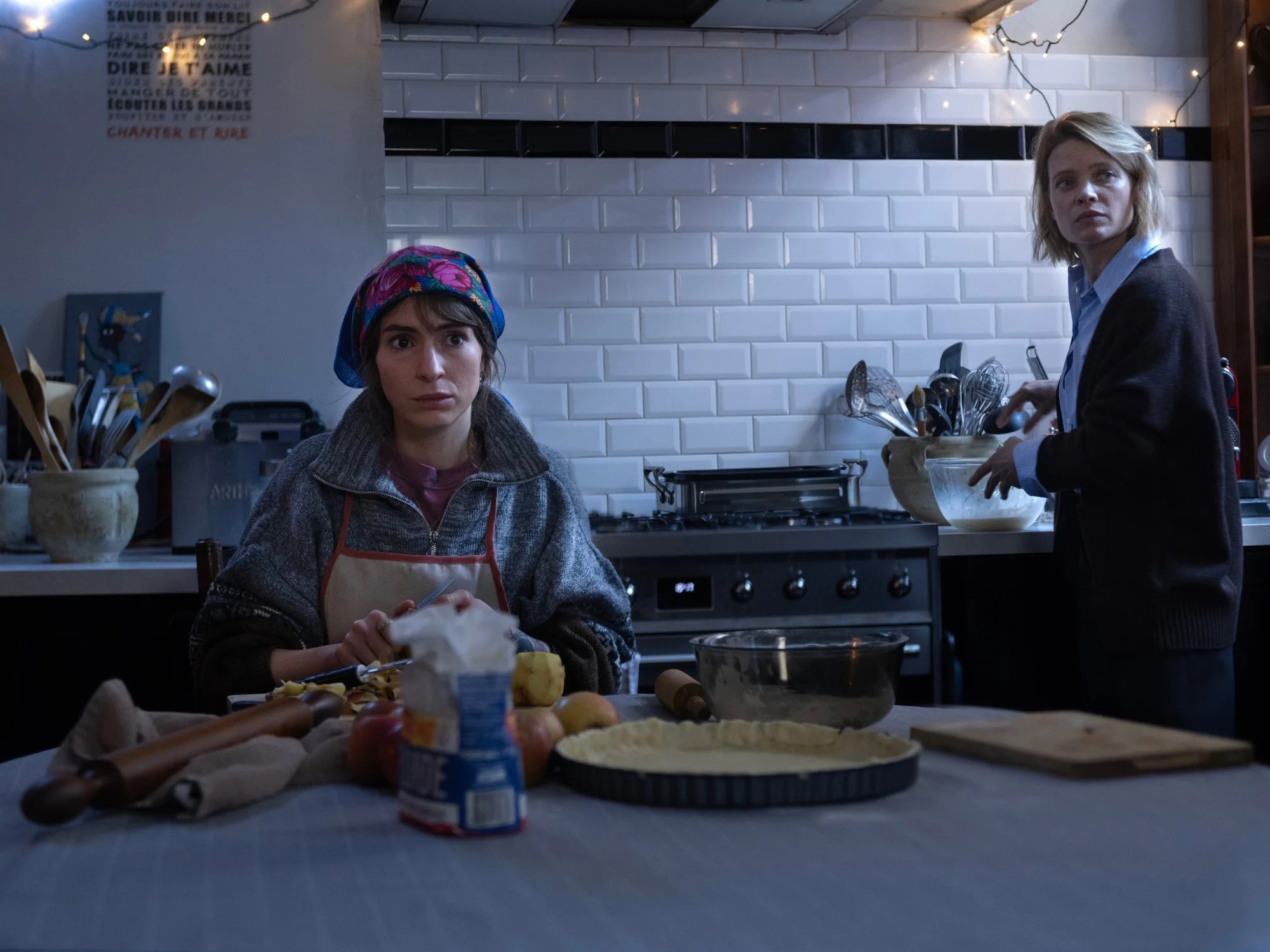
A young Romanian woman living in France works for a French family and joins a theatre company who are adapting Octave Mirbeau’s The Diary of a Chambermaid.
EN
Flavia Dima: In Le journal, there is a stark contrast between the highly polished, classically shot French scenes and scenes in Romania, which were shot on a smartphone. Beyond the diegetic motivation for this choice, was it also intended as a statement on the inequality between the two countries and, by extension, their film industries?
Radu Jude: Yes, that’s a possible interpretation. There is also a dramaturgical reason: the mother and daughter send each other video letters. But the filming technology has an aesthetic function and, I have to say, political one, even if that may be too large a word. Technology is not innocent; using it implies a decision. When I discussed the French portion with Marius Panduru, the cinematographer, I said: “I don't have intimate knowledge of the social and human realities of a family in France, in Bordeaux. I would like the film to be almost like an advertisement, with a degree of artificiality and cleanliness.” This can be read symbolically, but at the same time, I also see a degree of artificiality: as an honesty about my position toward the place where I was filming. That’s also why the casting is composed of actors who have appeared in other films – they are taken as ready-mades, with parts of their previous characters.
Another idea – which few people noticed – was the very strange location: an apartment full of very old things, in the centre of Bordeaux, belonging to a family of ophthalmologists who had lived there from the nineteenth century. The family lived on the top floor, while the rest of the apartment had been left almost as it was in the nineteenth century, apart from two or three newer elements. There is also a reason I chose Bordeaux: it was one of the cities massively developed through the slave trade. It was a small irony to set this story against that historical backdrop.
Regarding my critique of the film industry, I would nuance that slightly. I’m not bothered by films being made with a lot of money, or by those films making a lot of money. What strikes me, as technologies for creating and editing images become cheaper – potentially democratizing cinematic creation – is how closed certain structures remain. It’s still difficult for an amateur to make cinema, though there is a greater possibility than thirty, forty or fifty years ago. At the same time, budgets grow and the industry holds itself together like a kind of citadel, keeping these forms at a distance.
Flavia Dima in conversation with Radu Jude1
- 1
Flavia Dima, “Adaptation as Dialectics. Radu Jude on Le journal d’une femme de chambre (2026),” Sabzian, 30 September 2026.

